
Comparative Analysis
The future of engines will not be decided by tuning old systems a little better. It will be decided by which architecture can respond better to fuel change, emissions pressure, efficiency demand, and real-world product needs. That is where RVCR matters.
This page compares the structural limits of conventional engine systems with the comparative advantages of RVCR.
Structural Limits of Conventional Systems
Conventional engines have evolved impressively. But they still carry deep structural limits because the base mechanism has remained largely unchanged. The result is progress, yes — but mostly incremental progress.
Stroke–Bore Ratio Limits
- Conventional engines live inside a narrow geometric compromise. Bore and stroke must constantly balance speed, torque, combustion quality, cooling, and structural loading.
- Push one direction, and something else gives way.
Why this matters
- Combustion-chamber shape is constrained
- Piston speed rises quickly
- Friction increases
- Torque and rpm trade off against each other
- Packaging and cooling become harder

Legacy Slider-Crank Constraints
The slider-crank mechanism has powered the modern engine age. But it also locks engines into reciprocating mass, inertia reversal, vibration burden, and friction losses.
- The slider-crank mechanism has powered the modern engine age. But it also locks engines into reciprocating mass, inertia reversal, vibration burden, and friction losses.
- Engineers can reduce these penalties. They cannot remove them without leaving the mechanism behind.
Structural consequences
- reciprocating mass penalties
- inertia reversal
- second-order vibration burden
- friction-related losses
- balancing complexity
- limits to further efficiency gains through refinement alone
Turbine and Jet-Engine Limitations
- Turbines and jets are powerful in the domains they were built for. But they are not a universal answer to future shaft-power needs.
- They thrive in high-speed operating regimes. Many real-world applications do not.
Speed-regime dependence
Turbines work best at very high rotational speeds and within narrow operating envelopes. That is not always a natural fit for marine, industrial, off-highway, or distributed-power systems that need lower-speed, higher-torque output.
Flame stability and combustion constraints
Turbine combustion depends on stable flame behavior inside demanding flow conditions. As fuels change and operating envelopes widen, combustion stability becomes a more delicate challenge.
Power take-off needs added transmission logic
When turbine systems are used for shaft power rather than thrust, very high rotational speed has to be converted into usable output. That usually means added reduction gearing and transmission architecture.
Reduction gears add burden
Propellers, wheels, pumps, and generators usually do not want ultra-high-speed input. So the system inherits:
- reduction gearing
- transmission complexity
- added weight
- more packaging burden
- higher maintenance dependency
Multi-fuel flexibility is not automatically solved
Turbines may accept some fuel flexibility in certain cases, but they do not automatically solve the broader future-fuel problem. Different fuels still bring different combustion, handling, storage, and operating constraints.
Why this matters
The question is not whether turbines are useful. They are. The question is whether they are the best fit for lower-speed, variable-duty, practical shaft-power applications in a multi-fuel future.
Conventional VCR Methodology Differences
- Variable compression ratio has always looked promising. But conventional VCR solutions often arrive as added mechanisms bolted onto older engine architecture.
- That makes them heavier, more complex, and less elegant than they need to beKGYAT Engines-4.1.4.1 | Typical limitations
- cumbersome VCR gadgetry
- complicated VCR-related dynamics
- parasitic power demand for VCR drive
- higher cost, weight, and volume
- more difficult integration
Why Add-On Fixes Become Cumbersome
- As modern demands rise, legacy engines often respond by adding more correction systems. More control. More subsystems. More complexity.
- Each fix may help. But together they can make the whole engine heavier, costlier, and harder to future-proof.
The problem with incremental burden
- more corrective subsystems
- more packaging burden
- more complexity
- more cost pressure
- more maintenance burden
- harder adaptation to changing fuels

Why Legacy Architectures Struggle to Move Beyond Incremental Gains
- Legacy engines can still improve. But each next gain costs more and delivers less. That is the reality of mature architecture.
- When the base mechanism is already highly optimized, the next leap usually cannot come from more tweaking. It must come from a new foundation.
Why this creates a need for new architecture
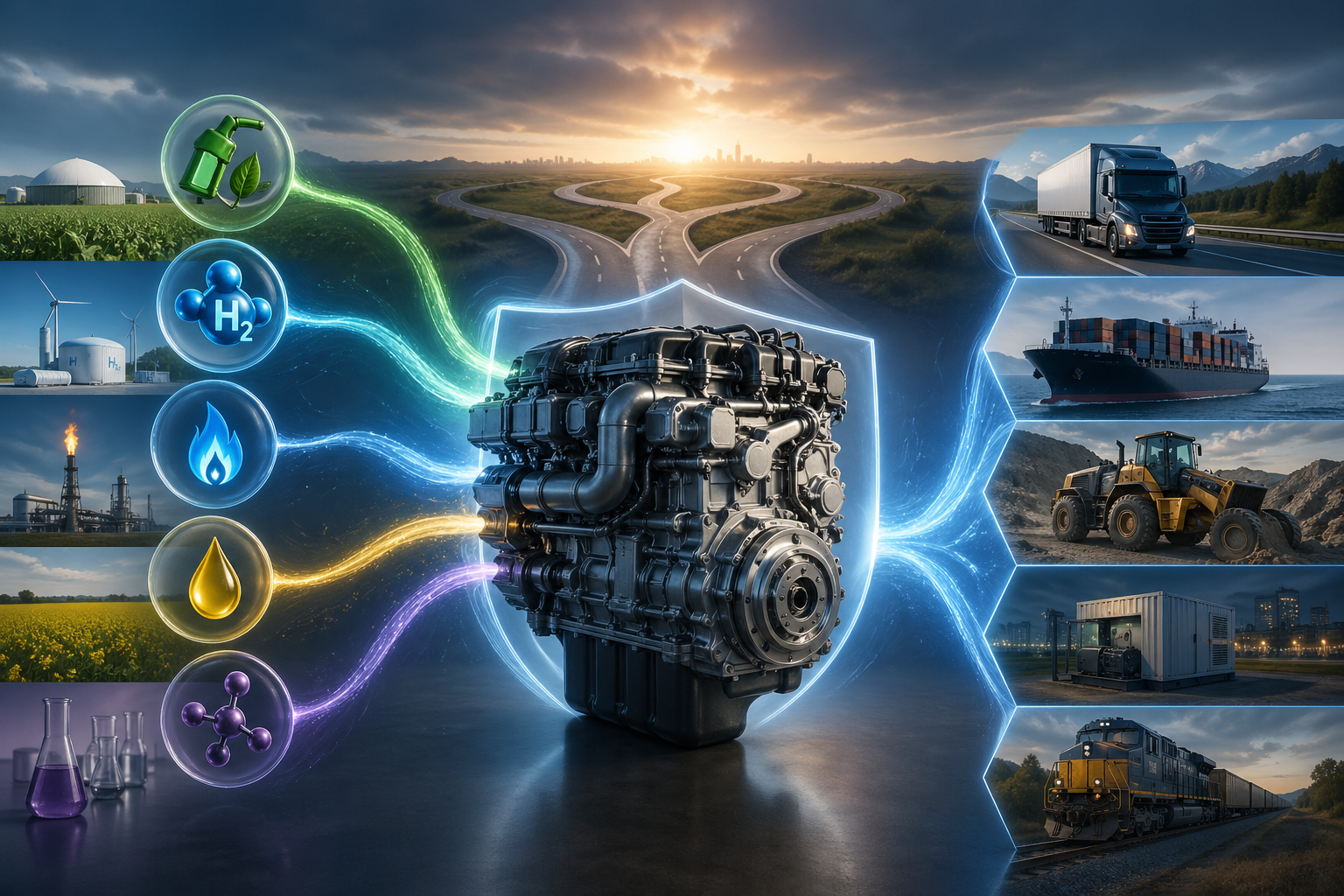
- Future engines need more than:
- tuning around old limits
- adding control layers to old motion systems
- optimizing one fuel at a time
- accepting fixed geometric trade-offs
- They need a deeper architectural shift.
Why This Comparison Matters
- This comparison is not about dismissing conventional engines. It is about recognizing where they stop scaling well into the future.
- Once the structural limits are clear, the need for a new engine methodology becomes easier to see.
Comparative Advantages of RVCR
RVCR is not just an improvement in one area. It is an architectural shift that influences performance, efficiency, combustion, packaging, fuel flexibility, and lifecycle value together.
That is why it deserves to be compared at the platform level.
Performance Gains
RVCR opens a broader performance path by moving beyond the motion limits of conventional engines. It points toward stronger torque behavior, higher usable output, and better high-load capability.
Key performance advantages
- high specific output potential
- improved power density
- VCR-induced high-load capability
- stronger torque relevance at slower speeds
- single- and dual-stroke pathway flexibility
- two double-acting piston logic within the RVCR framework
Efficiency Gains
RVCR improves efficiency through the architecture itself. Compression, leverage, heat addition, and friction behavior all move into a more favorable relationship.
Key performance advantages
- fuel-efficiency gains through VCR
- optimum power-to-economy ratio
- maximum mechanical leverage
- reduced FHP / BHP ratio
- reduced area and time for radiation losses
- constant-volume heat-addition logic
- reduced windage
- hydrodynamic lubrication support
Functional Advantages
RVCR is built for adaptability. It is better aligned with variable duty cycles, fuel diversity, and changing market requirements.
Key performance advantages
- step-less compression variation
- multiple-fuel capability
- smooth fuel change-over
- fuel switch-over to higher-calorific-value fuels
- dynamic compression-ratio control
- broader adaptability across changing fuel ecosystems
- platform flexibility across future engine formats
Combustion and Emissions Advantages
RVCR gives combustion control a more central role in the engine architecture. That creates a better path to both efficiency and emissions management.
Key combustion and emissions advantages
- desired peak pressure for thermal efficiency
- desired peak pressure for emission control
- dynamic compression-ratio control
- three-variable combustion control
- constant-volume heat-addition behavior
- lower-emission potential, including NOx and CO reduction pathways
- smoother transition from fossil fuels to greener fuel ecosystems
Mechanical and Packaging Advantages
RVCR simplifies the engine at a structural level. That matters for compactness, weight, integration, and future scalability.
Key mechanical and packaging advantages
- low mass / volume per HP
- no reciprocating parts
- no con rod / piston rod
- no gudgeon / top-end bearings
- piston weight reduction
- no entablature
- no dedicated flywheel in the conventional sense
- no crank case / relief vent arrangement in the conventional sense
- reduced valve gear
- compact, adaptable architecture
- external bearing access advantages
Reliability, Wear, and Operating Stability Advantages
RVCR’s advantages continue over time. By reducing conventional vibration, motion reversal, and wear burdens, it points toward a smoother and more durable operating profile.
Key reliability and wear advantages
- no inertia reversal in the conventional reciprocating sense
- no second-order vibration
- dynamically balanced rotors
- no piston slapping / chatter in the conventional sense
- lower wear rate
- reduced liner-related issues
- more stable operating motion logic
Better Breathing, Scavenging, and Process Flow
RVCR also improves the engine as a process system. Flow, scavenging, and service-related access can all benefit from the architecture. This reduces the need to rely only on bore increase and makes slow-speed, high-torque combustion more practical at the system level.
Key flow and process advantages
- flow-through scavenging
- displacement scavenging
- intake through piston face
- centrifugal coolant flow
- reduced valve gear dependence
- external open VCR controls
- easy external main-bearing access
Why RVCR Makes VCR Commercially More Viable
Conventional VCR often feels like a workaround added to an old engine. RVCR changes that. It makes variable compression part of the native logic of the engine.
That is a much stronger commercial proposition.
Key flow and process advantages
- RVCR helps overcome:
- cumbersome incremental VCR gadgetry
- complicated VCR-related dynamics
- parasitic power demand for VCR drive
- higher cost, weight, and volume of add-on VCR systems
- weak commercial elegance of conventional VCR solutions
Why RVCR Matters Now
- carbon concern
- efficiency demand
- emission demand
- alternative-fuel transition
- In that environment, marginal improvement is not enough. The market is starting to need architectural change.