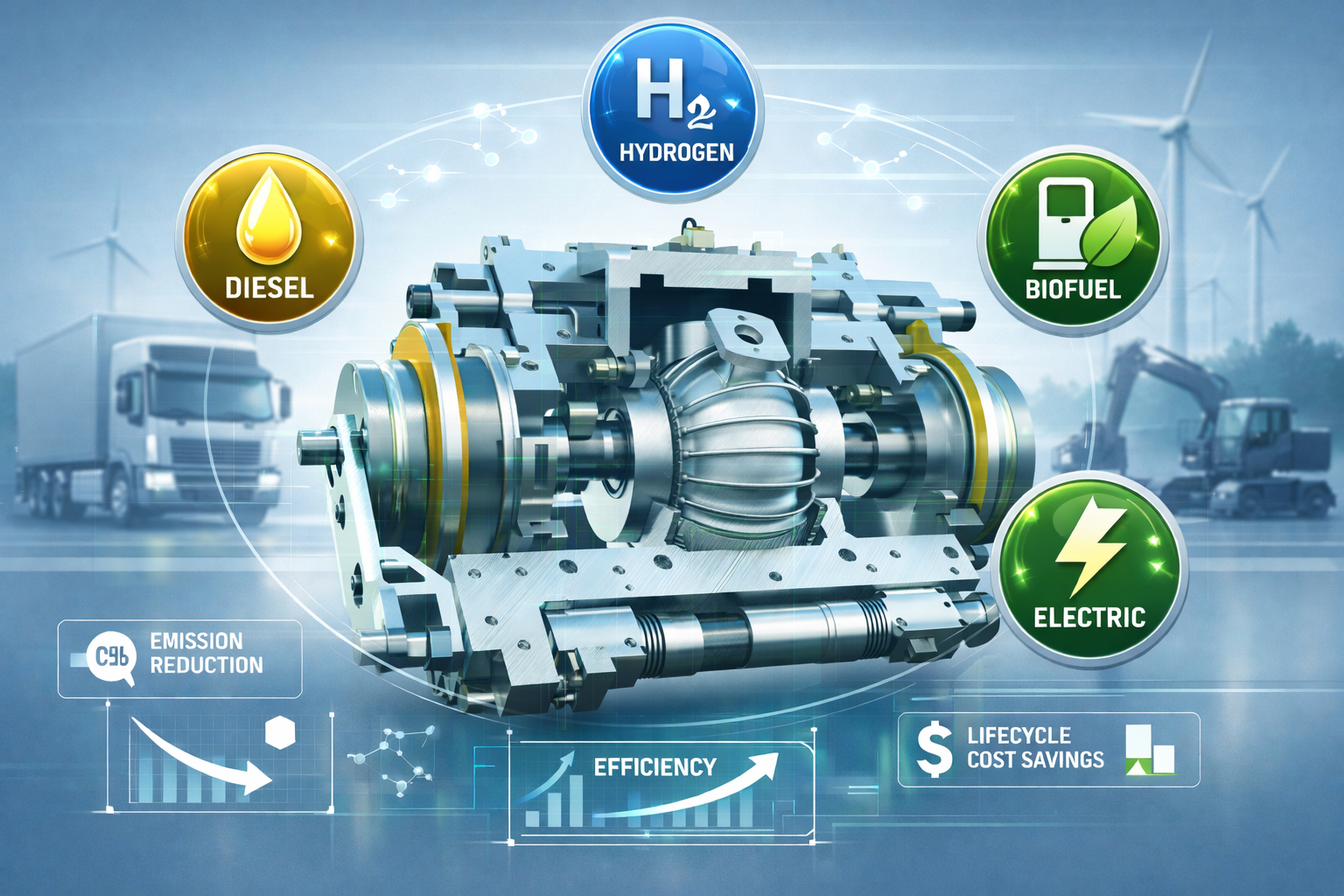
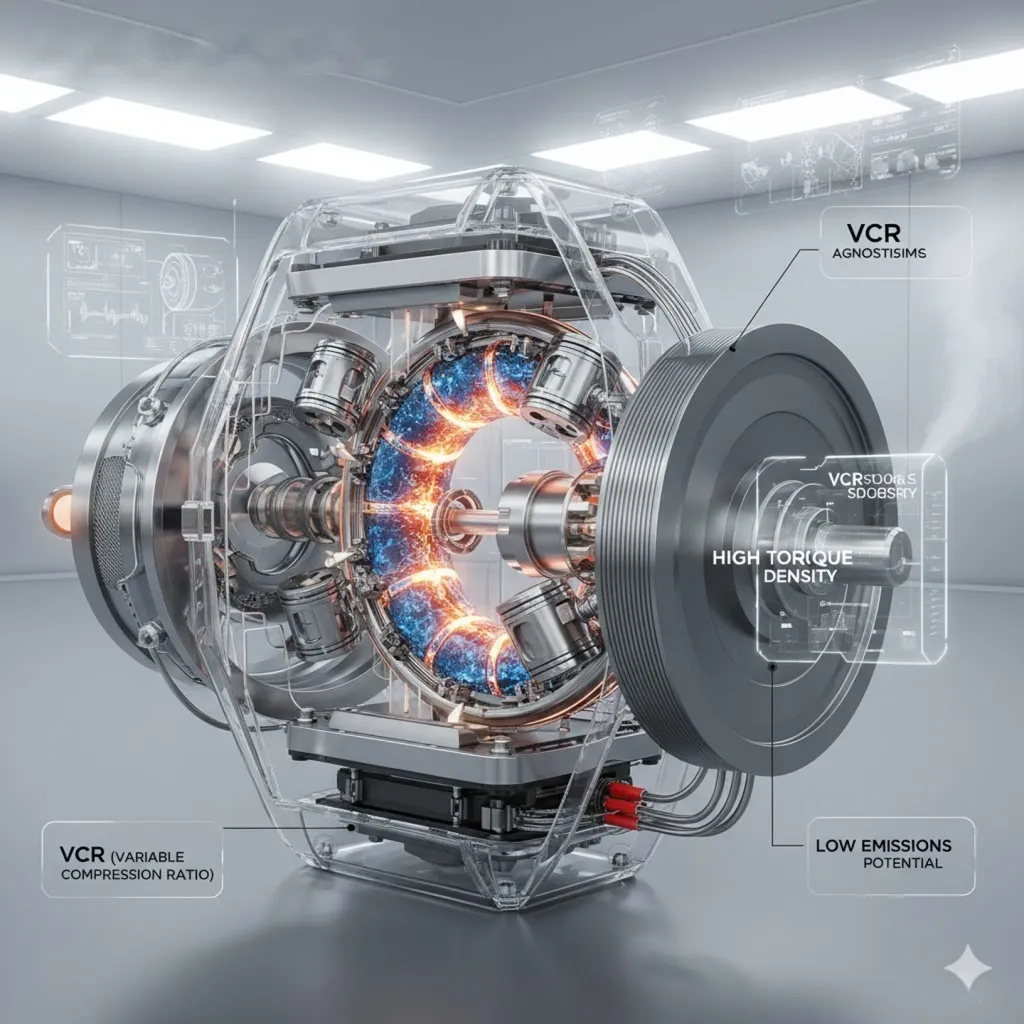
For any engine technology to transition from innovation to industrial reality, it must demonstrate not only technical superiority but also manufacturability, cost discipline, and scalability. RVCR and the RotoDyCo³™ architecture were conceived with these requirements embedded from the outset. Rather than adding complexity to legacy designs, RVCR simplifies the mechanical system while expanding functional capability—creating a pathway to industrial adoption across multiple power classes and applications.
Simplified Mechanical Architecture
Conventional variable-compression concepts typically rely on additional linkages, actuators, or movable assemblies layered onto an already complex piston–crank system. These approaches increase part count, manufacturing difficulty, and failure modes. RVCR achieves variable compression intrinsically, resulting in: – Reduced number of moving parts – Elimination of complex auxiliary VCR mechanisms – Lower assembly and calibration complexity A simpler architecture directly supports lower production cost and improved reliability.
Component Reduction & Manufacturing Efficiency
The rotary-dynamic layout of RVCR consolidates functions that are distributed across multiple subsystems in conventional engines.
This consolidation enables: Fewer high-precision components – Reduced machining and finishing operations – Streamlined assembly processes.
These characteristics are compatible with established industrial manufacturing methods, allowing OEMs to leverage existing capabilities rather than invest in entirely new production ecosystems.
Scalability Across Power Classes
RVCR is inherently modular. The same underlying kinematic principles can be applied across a range of displacements, cylinder counts, and output levels.
This supports: – Scaling from medium- to large-displacement engines – Adaptation to different duty cycles and speed regimes – Development of multiple product variants from a common core architecture
Such scalability enables OEMs to amortize development and tooling costs across diversified product portfolios.
Lifecycle Economics & Total Cost of Ownership
Mechanical simplicity, reduced wear, and improved combustion stability contribute to favorable lifecycle economics.
Key lifecycle benefits include: – Lower maintenance frequency – Reduced component fatigue and replacement – Improved uptime in continuous or heavy-duty operation.
These factors translate into lower total cost of ownership for operators, particularly in industrial and infrastructure-critical applications.
RVCR has been evaluated with a focus on integration into real-world OEM environments.
The architecture supports: Customization to application-specific requirements – Compatibility with existing supply chains – Structured joint-development and licensing models.
This ensures that RVCR is not confined to laboratory or niche deployments, but is positioned for scalable industrial rollout.
From Innovation to Deployment
By aligning mechanical innovation with manufacturing pragmatism, RVCR bridges the gap between breakthrough technology and commercial reality. It offers OEMs a viable pathway to deploy future-ready engine platforms without prohibitive cost or risk.