
Rethinking Combustion, Torque, and Machine Geometry
How RVCR enables a new pathway for slow-speed, high-torque, high-efficiency machine architecture.
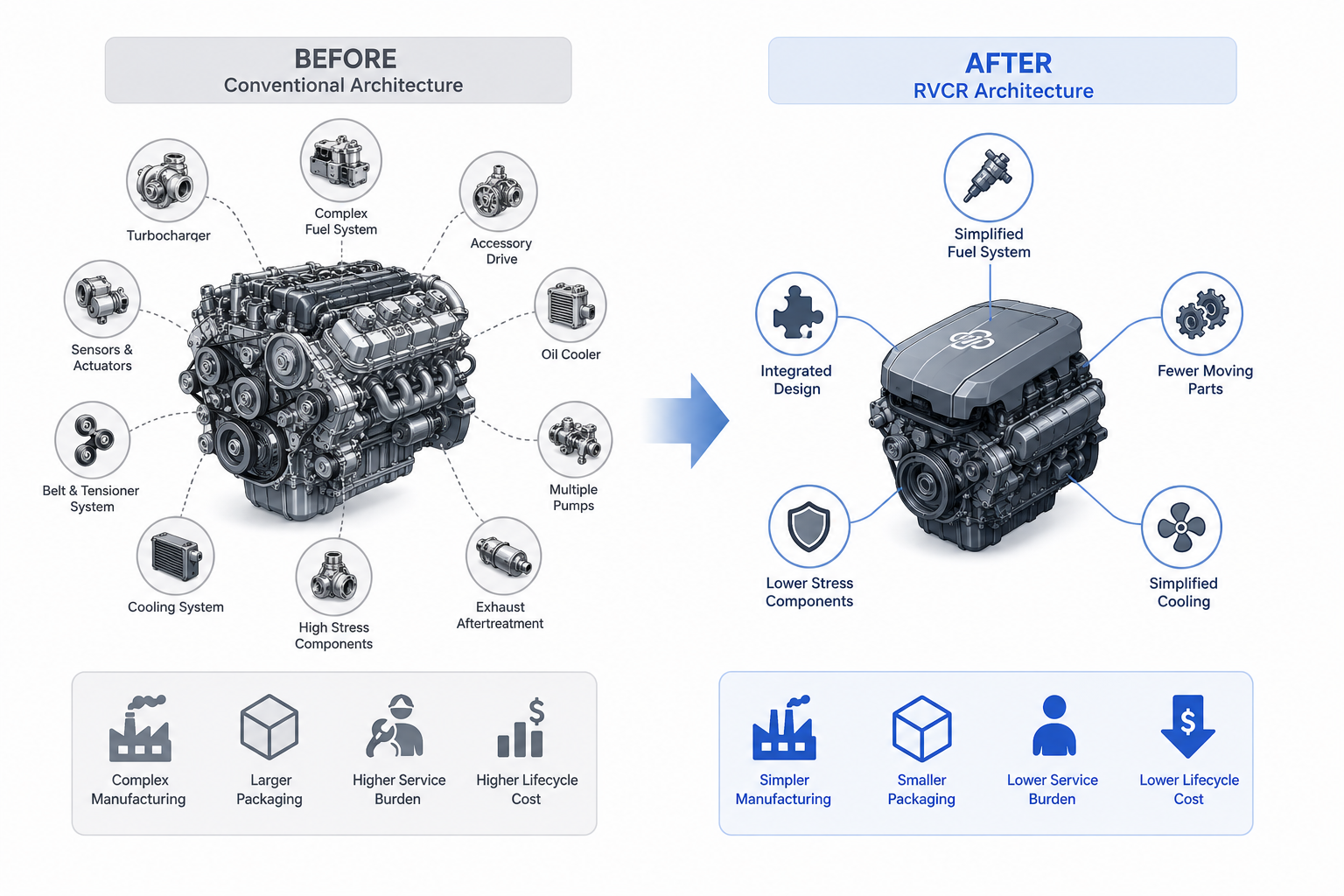
Conventional engines are constrained by the geometry and combustion limits of legacy piston-crank systems. RVCR introduces a different framework—one that rethinks how compression, combustion, expansion, torque, and thermal load can be managed within a machine. By combining new kinematics with longer residence time and a different effective lever-arm structure, RVCR opens the possibility of achieving strong torque at lower operating speeds while addressing key combustion and thermal limitations of conventional designs.
Why legacy engine architecture reaches a ceiling
In conventional internal combustion engines, power is a function of torque and RPM. Gasoline engines typically generate power through smaller fuel charges burned at higher RPM, while diesel engines rely on larger, energy-dense fuel charges burned at lower RPM to generate higher torque per cycle. In both cases, total output depends on the energy released per cycle and the number of cycles completed over time.
As engineers attempt to increase torque by enlarging piston diameter or displacement, a series of practical constraints begin to appear. Larger bores increase the volume available for combustion, but they also increase flame-travel distance, create greater structural stress, raise thermal loading, and add mechanical inertia. These factors limit how far conventional piston geometry can be scaled before efficiency, durability, and combustion quality begin to suffer.
Why increasing piston diameter is not a complete answer
Increasing piston bore can increase displacement and allow more fuel-air mixture per cycle, which in turn can increase torque. However, this approach introduces multiple engineering penalties. A larger bore extends flame-travel distance, which can make combustion less complete or less well controlled. It also increases heat concentration, structural loading, and piston mass. As piston size grows, side thrust against cylinder walls also increases, producing higher friction, wear, and bending effects on the piston structure.
These constraints reveal an important point: torque cannot be increased indefinitely by scaling diameter alone. A truly new machine architecture must address combustion timing, force transmission, leverage, and thermal behavior together—not as separate problems.
A different way to think about compression, expansion, and torque
RVCR is based on a different kinematic methodology from conventional slider-crank and rotary systems. Rather than relying on legacy arrangements, RVCR uses a rotor-based geometry with curved-piston motion inside a toroidal chamber to achieve alternating compression and expansion of fluids. This creates a new basis for energy conversion and enables machine architectures designed for higher efficiency, improved adaptability, and more advanced control over machine behavior.
Within the broader RVCR development philosophy, KGYAT focuses on turning this breakthrough mechanism into real industrial systems—from engineering design and simulation through prototyping, pilot product development, validation, and commercialization support.
How the RVCR toroidal concept changes combustion behavior
In the RVCR toroidal architecture described for this concept, two pistons operate within a toroidal chamber in a synchronized motion sequence. This arrangement creates a much longer residence time for the working fluid compared with conventional engines. Instead of combustion occurring as a near-instantaneous event within milliseconds, RVCR allows a more time-controlled process in which combustion can be managed more gradually.
This longer residence time creates the opportunity for multi-stage or stratified fuel injection. As a result, the design reduces dependence on rapid flame propagation across a large bore and allows better control over the rate of pressure rise. In principle, this supports more complete combustion, smoother energy release, and better adaptability across operating conditions.
Maintaining power at lower RPM through force and leverage
Power is proportional to torque multiplied by RPM. If RPM is reduced significantly, torque must increase proportionally to maintain the same power output. In conventional thinking, this often implies much larger displacement. Since piston area scales with the square of diameter, the diameter required to compensate for a major RPM reduction rises substantially. For example, reducing speed from 2000 RPM to 100 RPM represents a 20× drop in RPM, which would require 20× greater torque and approximately 4.5× larger diameter if area alone were used to compensate.
RVCR introduces another variable into this equation: leverage. Torque is the product of force and radius. That means torque can be increased not only by raising force through larger displacement, but also by increasing the effective lever arm. In the toroidal RVCR concept, the larger chamber radius contributes additional leverage, reducing dependence on extreme bore increase alone. This is one of the key reasons the architecture is theoretically suited to low-RPM, high-torque operation.
A more distributed thermal profile
Conventional engines often experience concentrated thermal stress in localized chamber regions. In the RVCR toroidal arrangement, heat is distributed along the chamber path rather than being repeatedly concentrated at one fixed hot spot. This can reduce localized thermal stress and improve heat distribution across the system. Remaining critical hot surfaces—such as piston faces—can then be addressed through targeted cooling strategies.
This is significant because thermal behavior is one of the main barriers to scaling conventional combustion systems. By changing the geometry of the chamber and the timing of the combustion event, RVCR offers a route toward better thermal management as part of the architecture itself.
Why this matters for next-generation machine development
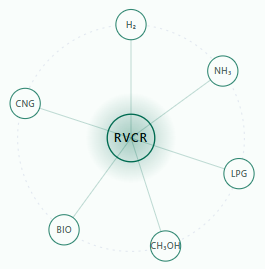
The RVCR approach suggests a path toward machines that combine low operating speed, high torque output, improved combustion control, and more distributed thermal loading. This could be highly relevant in applications where torque density, fuel flexibility, efficiency, durability, and lower-speed operation are commercially valuable.
KGYAT’s role is to advance such possibilities through structured engineering development—using advanced R&D, CAD/CAE modeling, prototyping, pilot execution, testing, validation, and milestone-based project delivery systems. This includes bespoke engineer-to-order development for application-specific pilot products and commercialization pathways.

Core technical insight
- Conventional engines are limited by combustion speed, bore size, thermal loading, and mechanical stress.
- Increasing bore alone is not an adequate long-term solution for low-speed high-torque power generation.
- RVCR changes the equation by combining larger effective displacement potential with larger effective leverage.
- The toroidal chamber concept enables longer combustion residence time and more controlled energy release.
- Thermal loads can be distributed more effectively than in conventional fixed hot-spot chamber designs.
- The result is a theoretical pathway to slow-speed, high-torque, high-efficiency machine systems.
From deep-tech principle to engineered product
RVCR is not positioned as an incremental refinement of conventional prime movers. It is being developed as a breakthrough machine-kinematics platform with the potential to unlock new classes of transport, power, and fluid-handling systems. KGYAT’s broader mission is to take the patented RVCR concept from theory to tangible machines through engineering design, prototype realization, pilot product development, and scalable commercialization support.
Explore the engineering potential of RVCR
Whether the goal is next-generation propulsion, cleaner prime movers, or advanced torque-oriented machine systems, RVCR offers a fundamentally new engineering framework worth evaluating. We work with partners to assess feasibility, develop pilot-ready solutions, and build the technical foundation for commercial adoption.