KGYAT’s development approach for RVCR and the RotoDyCo³™ engine platform is structured to move systematically from validated invention to industrially deployable technology. The roadmap emphasizes technical rigor, risk reduction, and scalability, ensuring that progress is aligned with real-world OEM and regulatory requirements.
Rather than pursuing rapid demonstration alone, the program is focused on building mechanism confidence, combustion validation, and manufacturability readiness at each stage.
Technology Readiness Progression (TRL)
RVCR has advanced through multiple stages of technical maturation, supported by simulation, analytical validation, and hardware-oriented development.
Current development has addressed: – Kinematic validation of the RVCR mechanism – Thermodynamic modeling and combustion feasibility – Mechanical integrity and load-path analysis – Scalability across displacement and speed regimes.
This progression establishes a strong foundation for transition from conceptual validation to system-level demonstration.
Simulation, Modeling & Virtual Validation
Advanced simulation has played a central role in reducing technical risk and accelerating development. Key activities include: – Kinematic and dynamic modeling of rotary-toroidal motion – Thermodynamic cycle analysis and efficiency estimation – CFD-based combustion and heat-transfer studies – Structural and fatigue analysis of critical components.
These tools enable early identification of performance boundaries and design sensitivities before physical prototyping.
Hardware Prototyping & Bench Testing
Hardware prototyping is structured to validate core principles incrementally rather than through monolithic demonstration units.
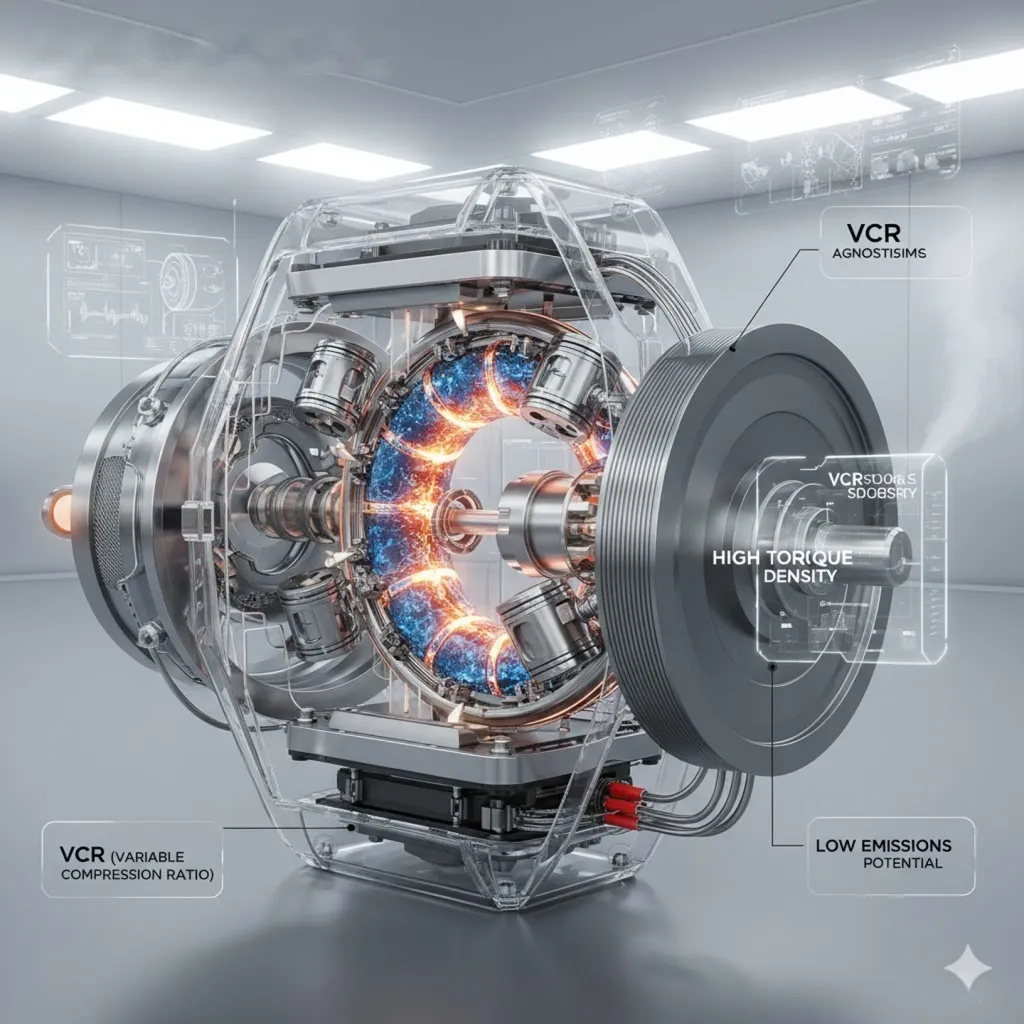
Prototype activities focus on: – Mechanism integrity and motion control – Sealing, lubrication, and wear behavior – Combustion stability under variable compression – Torque transfer and mechanical efficiency.
Bench testing provides empirical feedback to refine design parameters and validate simulation assumptions.
System-Level Integration
As subsystem confidence increases, development progresses toward integrated engine assemblies. This phase evaluates: – Control strategies for real-time compression modulation – Integration with fuel delivery and ignition systems – Thermal management and emissions behavior – Packaging and application-specific constraints System-level integration is essential to demonstrate readiness for OEM adaptation and pilot deployment.
The next phase of development is structured around collaborative pilot programs with strategic partners.
These pilots are designed to: Validate performance in representative duty cycles – Demonstrate durability under real operating conditions – Assess manufacturability and assembly pathways – Support regulatory and certification planning.
Pilot engagement is positioned as a joint learning and de-risking process rather than a pure demonstration exercise.
Path to Commercial Readiness
RVCR’s roadmap is oriented toward long-term industrial relevance. By aligning invention, validation, and manufacturability from the outset, KGYAT aims to shorten the transition from breakthrough concept to deployable engine platform. This disciplined approach ensures that RVCR development remains grounded in engineering reality, regulatory foresight, and OEM integration needs.