
The RVCR Engine Advantage
The RVCR engine platform delivers value by addressing the structural inefficiencies of conventional internal‑combustion architectures, not by incremental optimization. Its advantages arise directly from the underlying rotary‑dynamic kinematics, enabling performance, efficiency, and adaptability that remain difficult or impossible to achieve with piston‑crank systems.
These advantages are particularly relevant for OEMs and operators navigating fuel uncertainty, tightening emissions regulations, and increasing lifecycle cost pressures.
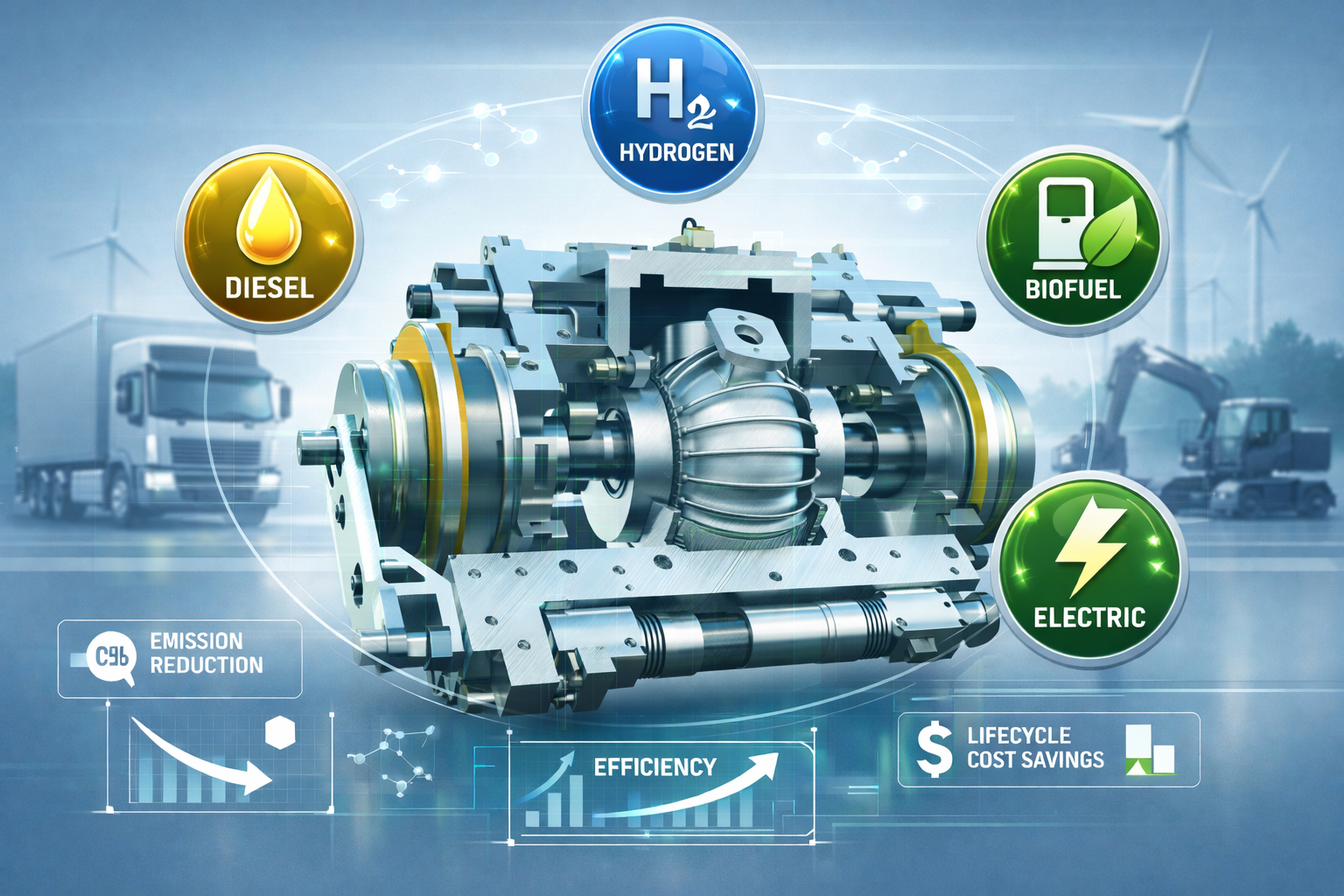

Higher Efficiency Across Operating Ranges
Conventional engines achieve peak efficiency only within narrow load and speed bands. Outside these conditions, fixed compression ratios and sub‑optimal force transfer result in energy losses.
RVCR engines maintain higher efficiency across a broad operating envelope by: – Enabling real‑time compression modulation to match fuel and load – Preserving optimal mechanical leverage throughout the expansion cycle – Reducing friction and inertial losses through rotary motion.
The outcome is consistently higher usable energy conversion, rather than isolated peak performance.
Emissions Reduction Through Combustion Control
Emissions formation is fundamentally linked to combustion temperature, pressure, and burn completeness. RVCR enables direct control over these parameters via adaptive compression and synchronized combustion timing.
This allows: – Lower peak combustion temperatures, reducing NOx formation – More complete burn cycles, minimizing unburnt hydrocarbons – Improved adaptability to emission regulations across regions.
Rather than relying solely on exhaust after‑treatment, RVCR addresses emissions at the combustion source.
Real‑Time Fuel Flexibility
Future energy systems will involve multiple fuels—synthetic fuels, bio‑fuels, transitional hydrocarbons, and emerging green alternatives. Most engine platforms remain fuel‑locked by design.
RVCR engines are inherently fuel‑agnostic, allowing: – Real‑time switching between compatible fuels – Optimization of compression and combustion for each fuel type – Reduced dependency on dedicated fuel supply chains
This flexibility enables operators and OEMs to adapt to fuel availability, cost, and regulatory constraints without redesigning the engine platform.
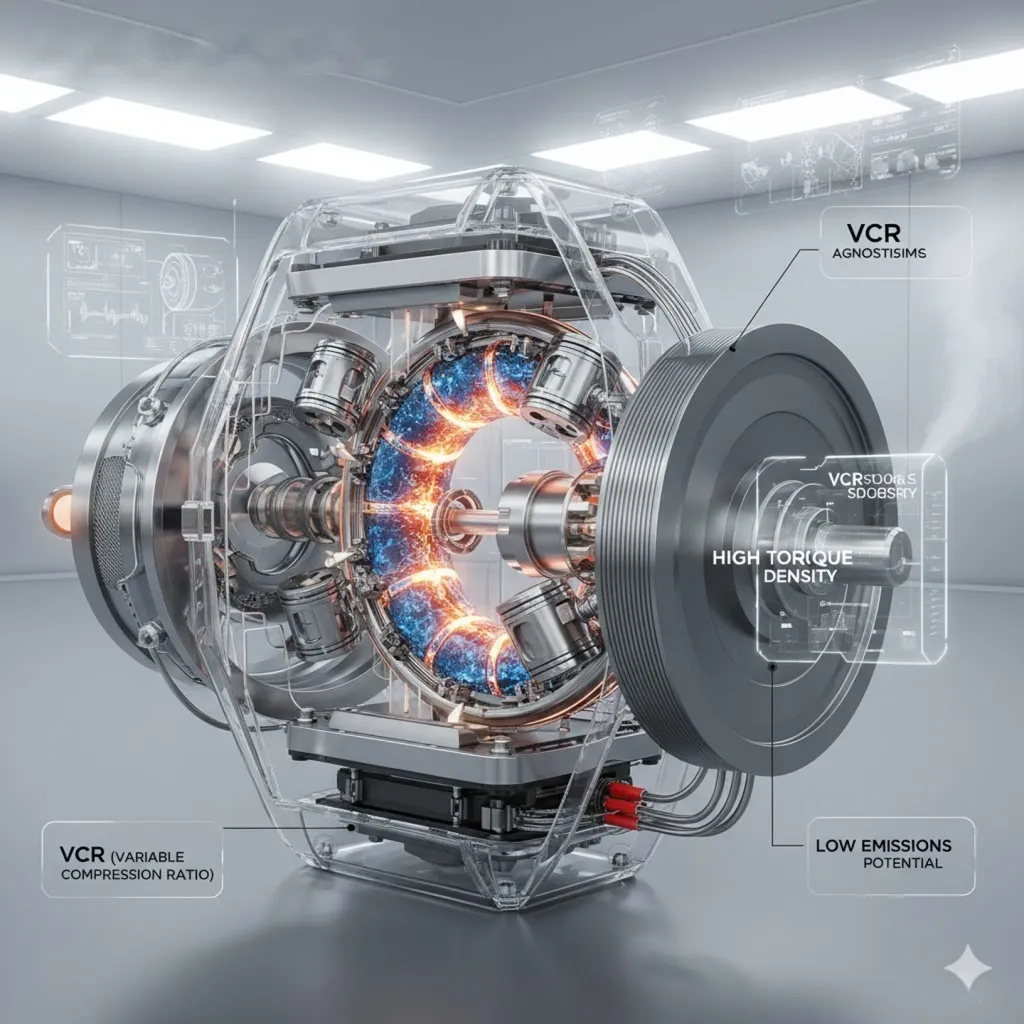
Combustion Dynamics and Emission Control
RotoDyCo³™ is a rotary‑toroidal energy‑conversion architecture based on the RVCR mechanism. By replacing reciprocating kinematics with controlled rotary motion, it enables native, real‑time variable compression without external actuators or mechanical complexity.
Key architectural outcomes include: – Continuous compression‑ratio modulation – Direct torque transfer through the entire expansion cycle – Superior mechanical leverage and reduced losses
The result is a combustion system that is inherently adaptive rather than conditionally optimized.
High Torque Density at Low Speeds
By maintaining favorable force orientation throughout gas expansion, RVCR engines generate high usable torque at lower rotational speeds.
This delivers: – Superior torque‑to‑weight ratios – Reduced need for high RPM operation – Lower mechanical stress and vibration
Such characteristics are particularly valuable in heavy‑duty, marine, off‑highway, and power‑generation applications.
Reliability, Wear & Maintenance Benefits
Elimination of reciprocating masses and reduction in sliding interfaces significantly lowers mechanical wear. The RVCR architecture also enables more stable lubrication regimes and reduced peak loading.
Benefits include: – Lower wear rates over operating life – Reduced maintenance intervals – Improved durability under continuous or high‑load operation. These factors contribute to improved availability and lower total cost of ownership.
Cost & Lifecycle Economics
RVCR engines simplify mechanical architecture by reducing part count and eliminating complex auxiliary systems required for variable compression in conventional designs.
Lifecycle advantages include: – Simplified manufacturing pathways – Reduced component stress and replacement – Scalability across multiple power classes using a common architecture
The result is a platform that is not only technically advanced, but also commercially viable at industrial scale.
A Platform‑Level Advantage
Taken together, these benefits position RVCR as a platform technology rather than a single‑use engine design. It enables OEMs to develop future‑ready product lines capable of adapting to evolving fuels, regulations, and market demands.